
Welcome to the Measured Memo, a concise note that shares our perspective on private investing and income-producing assets. We aim to make this the most value-packed investing read of your quarter. Let’s go.
Market
For the past four years, the story of investment real estate has been a macro story. Interest rates rose dramatically, transaction volume dropped, and many markets were tasked with absorbing more new supply than their populations could support. The combination created a challenging operating environment and a significant repricing of assets across the board.
That chapter is closing. What is replacing it is more nuanced and, frankly, more interesting.
We no longer see one market for commercial real estate or multifamily communities. What we see instead is dispersion, with different markets and different asset classes behaving in ways that defy the conventional wisdom that shaped the prior decade.
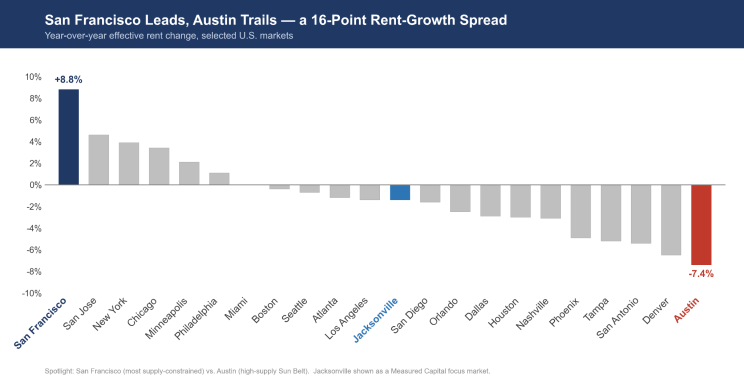
Consider two cities. San Francisco, long considered one of the most hostile regulatory environments for multifamily owners in the country, now posts the highest rent growth in the United States. Austin, a high-growth, landlord-friendly market that attracted enormous investor capital throughout the boom years, now sits at the opposite end of the spectrum, with rents declining sharply and asset values roughly 30 percent below where they stood just three years ago. Specifically, San Francisco is seeing rents rise about 9 percent, while Austin apartments have cut rents by more than 7 percent. That outcome would have seemed implausible four years ago. Yet today it is the reality.
The same divergence is playing out across asset classes. Workforce housing, historically the highest-returning segment within multifamily, is now under meaningful stress. Rents are negative in many submarkets, concessions are widespread, and operating expenses continue to climb. Class A and B assets, traditionally viewed as the lower-return safe harbor, are now the beneficiaries of rent growth. Concessions are burning off, and net operating income is rising. The historical pattern has been inverted.
What matters most is the lesson embedded in these trends. And trends, by definition, move over time. San Francisco will not outperform Austin indefinitely. Class A buildings will not forever carry the returns that workforce housing historically produced. The data will eventually revert to its historical mean. The question for a disciplined investor is not which trend to chase today, but what actions can be taken now.
Strategy
For investors with a long view and the patience to let execution compound, the current environment is not a reason for caution. It is a reason to act.
Two principles guide how we are moving through it. The first is to control what we can control. The second is to let the trend work for us rather than against us.
On the first: this cycle made clear that broad market forces are outside any operator’s control. The 5-year Treasury sits at 4.25 percent as of this writing. In 2020, it was 0.25 percent. To put that in practical terms, a deal that penciled beautifully in 2020 at that cost of capital does not pencil at all today. That is the whole story of the past four years. We have internalized that lesson fully. Our job is to execute within the environment that exists, not the one we expected. That shift in orientation, from hoping for a better macro to optimizing within the current one, is where disciplined operators separate themselves.
On the second: we are deploying capital where the trend supports us. That means targeting newer-vintage assets, built 1985 or later, in clear A and B submarkets, selected down to the street level. It means identifying distressed capital stacks where the underlying asset is sound but the financing structure has become untenable, and buying properties that are pinched by market conditions rather than operational failure.
Internally, we remain obsessive about the performance of every existing door, with particular focus on renewals, leasing velocity, collections, and expense control. The environments that feel most uncertain are often the ones that reward preparation the most. We have been preparing for this one for three years. The summary of our current posture is simple: optimize every existing asset while selectively buying the dip.
Portfolio
The gap between where we started as operators and where we stand today is the most important story in our portfolio right now.
In Jacksonville, we just completed two cash-out refinances, a direct reflection of both asset value and lender confidence in the underlying performance. Those transactions recycle capital without requiring a sale, extend our runway, and validate the underwriting thesis we brought to those deals. Class A and B assets acquired since 2024 are performing at or above expectations across both markets. The thesis is playing out, and operational momentum in those assets is strong.
We also own assets on the other side of the dispersion story, and we want to be straightforward about that. Workforce housing properties acquired in 2022 and 2023 are experiencing the market pressures we described above. Rents are flat, concessions are required in some cases, and near-term performance is below original projections. These are market-driven conditions. Our focus on those assets is clear: protect occupancy, control expenses, and manage toward the best available exit on a timeline that serves investors.
The forward pipeline is active and encouraging. We have one new acquisition in process and several letters of intent under review. We have also been outbid on a number of assets recently, which tells us something useful about where the market is heading. Quality capital is returning, competition for well-located assets is real, and the bid-ask gap that froze transaction volume for three years is closing. We will not chase deals that do not meet our return thresholds, but we are seeing more opportunities that do than at any point in the past two years.
The cycle is turning, and we are in a strong position to take advantage of it.